I've always considered myself a builder. A tinkerer. Someone who looks at a problem and reaches for a solution rather than waiting for one to arrive. But early on, when my grandmother suggested I become an engineer, I quickly shrugged it off. I had already decided what I was going to do with my life. I was going to become a CPA, like my dad. I never looked back. I put in the work, got the credentials, and spent roughly the past decade building a career in it.
Turns out grandma was onto something, because I ended up becoming something of an "engineer" after all. Albeit, maybe not in the way she envisioned.
I started experimenting with AI in my work in late 2023, trying to automate pieces of it, with mixed results at best. The models progressed exponentially, and when the coding agents arrived, everything changed for me. These agents didn't just generate text. They could write and execute real logic and work through complex workflows step by step. I went all in: stress testing them against real scenarios, learning to structure prompts for consistent output, breaking things, rebuilding them, and developing the guardrails that are now central to how I work.
The full unlock came in January of this year, when I started using Claude Code in the terminal. Something clicked. I wasn't just automating tasks anymore. I was building again, but now in software. I've since used these agents to solve my own problems: in my practice, in my personal life, across every area where I saw friction and decided to build my way through it. The things I've shipped in the past year, apps, internal tools, real workflows running in the real world, are the proof of concept. Not just that AI works, but that someone without a traditional engineering background can build things that matter with it.
The confidence that comes from that is hard to describe. It bleeds into everything: your work, your ideas, your sense of what's possible for your own life. I'll be honest, I no longer see limitations the way I used to. I've come to believe that almost anything is possible if you put your mind to it and put in the time and effort it demands. Right now, the only real limitation is the one between your ears: your own beliefs about what you're capable of. Remove those, and you can start building the life you actually want.
That might sound grandiose. But it's just how I feel after a year of proving it to myself, one build at a time. I want everyone to experience that unlock.
What I Believe
I believe AI is one of the greatest opportunities we've ever seen. A genuine force for good, and a way to elevate the potential of anyone willing to learn it and see it that way. But like most things of magnitude, it carries real risks. The key is refusing to let fear of those risks blind us to what becomes possible when we approach it with intention, skill, and purpose.
Notice I said willing to learn it. That's the whole game.
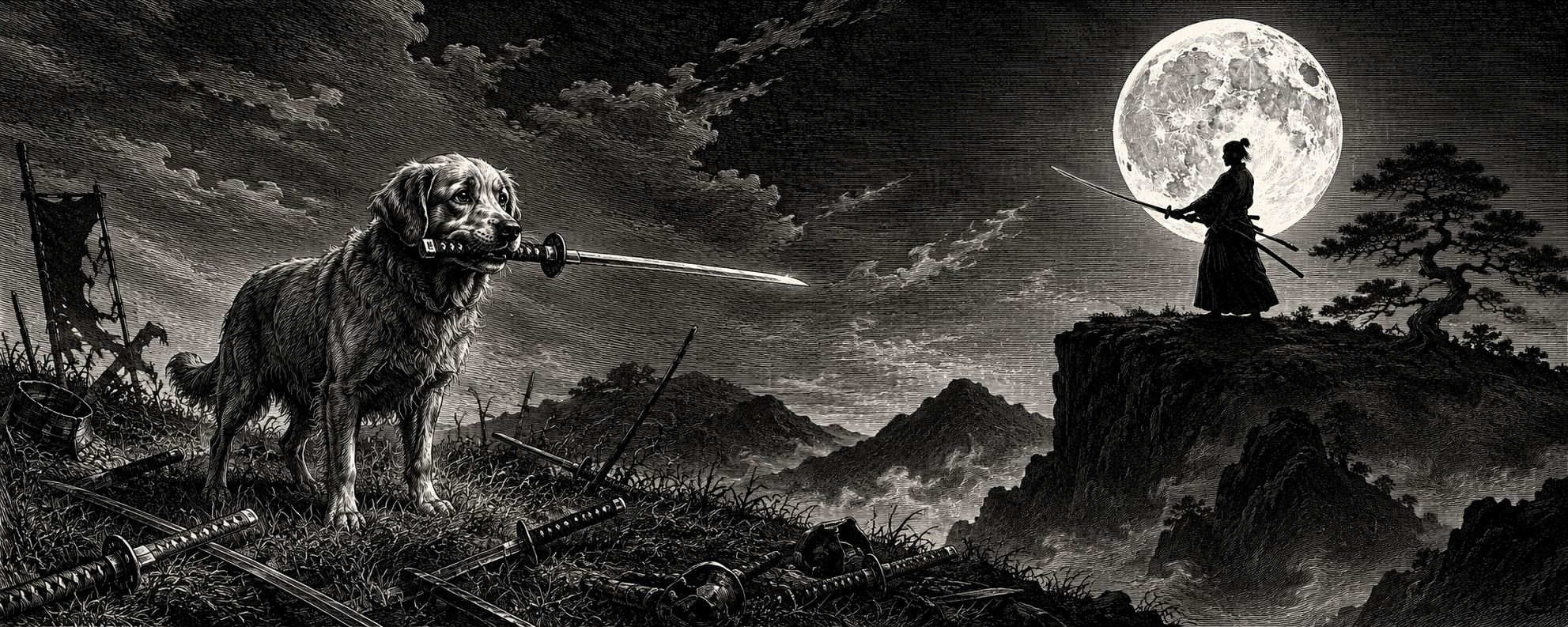
AI is a tool, and like any tool, it's only as good as the hands wielding it. You wouldn't be afraid of a dog trotting around with a sword in its mouth. Put that same sword in the hands of a samurai, and everything changes. Most people interacting with AI today are the dog. They've got the sword, but no idea what to do with it.
Don't be the dog. Be the samurai.
But nobody is born a samurai. You earn it by sharpening the blade. In this craft, sharpening means the unglamorous work most people skip: setup, prompting, guardrails, governance, documentation. When someone tells me AI doesn't work for them, my first question is whether they ever went back to figure out why. Most haven't. But if you actually go back and look, you'll almost always find the same thing: a setup error, a bad prompt, something that could have been prevented before the first word was generated. The failure is almost never the model. It's the unsharpened blade.
Don't get me wrong, these models aren't perfect. Neither am I. They make mistakes, and so do I. But learning how to reduce the frequency and magnitude of those mistakes is what drives the output. That's a learnable skill. I believe anybody can learn it. It takes time. It takes reps. But such is life.
Elevation, Not Automation
The right framing for AI isn't automation. It's elevation.
AI handles the routine, repeatable work that has always eaten our calendars: classification, drafting, research, first-pass review. That was never where our real value lived anyway. What it gives us back is time for the work that actually matters: the thinking, the judgment, the relationships, the problems worth solving.
Think of automation as the precursor to elevation. It clears the path. But if automation is where it ends, if we just automate the grind and never do anything more with the time we get back, then we've missed the point entirely. I'd argue that's failure. The goal was never to do less. It was to do better.
We move from reactive to proactive. From clearing this week's backlog to actually thinking about the work, and the life, in front of us. That's the elevation.
Why This Is Personal
I see this most clearly in my own profession, because I grew up inside it.
I'm a second-generation CPA. My dad is almost 70 years old and still works 6-7 days a week. He has owned a small public accounting firm for forty years, and even with ten or twelve employees, he still carries the heaviest load in the building. Tax prep, tax review, compilations, client questions, admin. He does it all because his clients depend on him, and he refuses to let them down. I admire that dedication more than I can put into words. But I also know the toll it takes, because the tools that could meaningfully lighten that load have only recently become accessible, and most small firms haven't had the time or bandwidth to reach for them yet.
I love my dad dearly and respect him entirely. He set the standard that I hold myself to every single day. And there are thousands of CPAs out there just like him: dedicated people who are too buried in the work to start learning the very thing that could dig them out. That's the problem I can't look away from. And it's why the people who carry this profession are exactly who I want to reach first.
To be clear, I'm not scolding my dad for not using coding agents. I'd genuinely love it if he did, and it would be a lot of fun to watch. But the real target audience is our generation and the ones coming up behind us. The practitioners who still have decades ahead of them and the time to build new habits, new workflows, and new ways of working before the window closes.
The Stakes
This matters more, and sooner, than most practitioners realize.
Small CPA firms are about to be forced to adopt AI, whether they want to or not. Larger firms are building sophisticated AI-driven platforms increasingly capable of serving the same clients small firms have historically owned. The small firm's natural moat of locality, direct relationships, and personal trust has already started eroding. COVID made geography less relevant for this work. AI platforms will accelerate that. If small firms don't adopt over the next five years, they'll be defaulted out of competitive viability. Not by AI itself, but by larger firms with AI platforms eating their client base.
Add a profession in a pipeline crisis, with fewer people sitting for the exam and fewer entering the field at all, and you'd think the outlook is bleak. I see the opposite. Right now is the best time in history to be a CPA. The play isn't to resist. The play is to adopt skillfully, with discipline, and use AI to amplify what small firms already do better than anyone: maintain real relationships and deliver judgment that scales to each client's specific situation.
The Mission
If I had to put it in one sentence: help people embrace and use AI to elevate both their personal and professional lives beyond what they previously believed was possible.
Here's what that looks like in practice.
For CPAs and firms: our profession needs a practitioner-led infrastructure for adopting AI safely and well. That means firm-level policies, engagement letter language, documentation standards, real use cases, and risk frameworks that actually reflect how small firms operate. The professional layer that turns AI from a tool we're afraid of and something of an unknown into a tool we leverage to elevate our profession and the services we provide to the clients who depend on us.
The goal isn't to blindly adopt automation. It's for our profession to take on the challenge of shaping how AI integrates into our work: refining the outputs, defining the guardrails, and setting the standards ourselves, before others come in and do it for us.
Right now, the large firms and companies have the resources to figure this out on their own. They have legal teams, risk departments, and dedicated technology staff building internal policies and governance frameworks. But solo practitioners and small to mid-sized firms know this work just as well, if not better, than anyone. We know what true quality looks like. We understand the integrity this profession has carried for generations, and we have an obligation to make sure that standard doesn't get compromised in the rush to adopt something new.
The solo practitioners and small firms out there don't have this level of resources. The guidance that does exist isn't always clear enough, or understood broadly enough across our profession, to translate into action at the firm level. That gap is a real problem, and it creates an uneven playing field at exactly the moment when the stakes are highest. My hope is that the AICPA, state societies, and other governing bodies step up and provide clear, actionable guidance so that every practitioner, regardless of firm size, can use these tools safely, responsibly, and competitively. Small firms shouldn't have to wait for the profession to catch up while larger competitors pull further ahead.
And I'm not waiting on the sidelines for that to happen. I reached out to my own state society and implored them to address AI more directly, and they've been genuinely receptive. I'd implore you to do the same: reach out to yours. The more practitioners who raise a hand and say this matters, the faster the whole profession moves.
For everyone else: this isn't just a CPA story. Accounting is where I'm starting because it's where I built my career, and I have a genuine passion for working with individuals, business owners, and fellow CPAs. But the same unlock is available to anyone. If you've written AI off as too complicated, not relevant to your work, or just not for you, I hope to change your mind. The confidence and capability I've gained over the past year are not unique to me. They're available to anyone willing to pick up the sword.
Ultimately, I'm doing this because I believe the future belongs to those who prepare for it today. And the future is coming whether we like it or not. No one knows exactly what it will look like, but the signs are there. The question is whether we take action now to make sure we're capable of capturing the opportunity when it arrives. In order for firms like my dad's to thrive in the next decade, and not just survive it, we are going to have to adapt. I hope they do, because the small-firm tradition of our profession is worth preserving.
I hope this motivates everyone who comes across it. Start building. Work towards solving the problems that exist in your life today. Help others around you. Ask questions and work to figure out the answers. Be the type of person who hands the next generation a sharper blade, not the one who tells them not to swing it. I'm going to keep on keeping on and helping those around me, especially my fellow CPAs and tax pros, and working to move the profession forward. Because the future isn't something that happens to you. It's something you build.
So, pick up your sword and start sharpening your blade.
Charlie Barmore, CPA, CFE, CVA · @cbarmorecpa
AI-Native CPA. I build the tools I use.