

I think AGI is here.
That is a contested claim, and so is what AGI actually means. But consider a system that can reason through unfamiliar problems, use tools, move between domains, and carry substantial assignments a long way toward a finished result. By that standard, I think the latest models have crossed a practical threshold.
They still make mistakes. Long, open-ended assignments can still require substantial intervention. But the range of work I can hand them is why I think the description fits.
Fable 5.1 and GPT-6 Astra are a large part of why I’m saying that now. Anthropic describes advances in sustained coding and knowledge work. OpenAI describes a model that can operate computers, carry out multistep professional workflows, and adapt as requirements change.
Turning those capabilities into reliable accounting work takes context, working systems, clear direction, and review. That is where the implications for our profession become interesting.
I use agents across various areas of my life and practice: writing, software development, research, and much more. Right now, I am the one driving and steering the agents and remain very much in the loop, but I can feel myself becoming my own bottleneck. Each one may be doing useful work, but they all need a piece of my attention before they can continue.
That experience gives me a glimpse of a different problem for accounting firms:
How do we organize the work when we can delegate much more of the execution, but still need to understand and take responsibility for the result?
The assumptions behind the firm are changing
Much of the way firms operate makes sense when professional labor is expensive, expertise takes years to develop, software needs someone to operate it, and information is scattered across files and applications. Each person can prepare, review, or keep track of only so much work.
Those constraints have helped shape staffing, billing, review processes, management, training, and client communication. If general-purpose intelligence can take on more of the production and coordination, I think we need to reconsider the structures we’ve built around those limits.
The question I want to explore is:
What does accounting look like when intelligence and execution become cheap?
We will delegate larger responsibilities
Most AI use still requires a lot of active coordination. Give the model a file, explain the task, review the answer, correct something, give it another instruction, and move the useful output somewhere else.
Even when each step is faster, we’re carrying the assignment in our heads and moving it forward. I expect the size of what we can hand off to grow considerably.
Eventually, I should be able to say:
“Keep this client ready for review. Handle what you can and bring me anything that needs a decision.”
The responsibility would continue as information arrives. The agent would update the work, identify gaps, and move toward the review points we’ve agreed on. I wouldn’t need to restart the assignment every time another document shows up.
That changes what I have to be good at. I need to explain the objective, understand what the client cares about, decide which assumptions are acceptable, and establish where I want to be involved. The agent can work through more of the mechanics between those conversations.
It also changes the staffing question. A larger book of work may require a different mix of preparation, review, and client-facing capacity. The time an assignment takes a person today becomes a less useful starting point for deciding how to deliver and price that service. We’d have to understand the full cost of getting to a useful result, including the review.
Human control needs a better design
I believe humans should remain in control of professional work. I also think we need to be more precise about what that means as agents take on larger assignments.
If every agent needs me to resolve every uncertainty, adding more agents can create more coordination work than I can absorb. The system needs a way to distinguish between a routine question it can resolve and a decision that deserves my attention.
That means establishing:
- What an agent can do on its own, and what it can reasonably infer.
- What another agent can check or review within the authority we’ve given it.
- Which decisions require our approval or a conversation with the client.
- What can wait for a planned review and what warrants an interruption.
I’ve started thinking of this as escalation architecture. It’s the design of when work should continue and when it should come back to a person.
I suspect firms that get good at this will have an advantage even when they’re using the same models as everyone else. They’ll be better at using the attention of their people.
When a partner or manager opens the workspace, the first question should be, “What needs me?” The answer might be a short list of decisions across several engagements, with enough context to understand why each one matters.
Elsewhere, an agent might be preparing a forecast or tracking missing information. We should be able to see whether that work is progressing without receiving a separate presentation about every routine action. And we should be free to look more closely whenever we want.
Bigger handoffs make understanding more important
The less of the production we do ourselves, the more deliberate we have to be about getting oriented when we return.
I refer to this as the catch-up cost:
The time, energy, and effort a human spends figuring out what an agent just did before they can trust any of it.
Agents tend to overproduce. If we wait until the end to review, figuring out what they did can consume the time the automation saved. Useful stopping points matter, and so does how the work is presented when we reach them.
A folder full of completed files and a long summary still leave me with a lot to reconstruct. I want the agent to be able to show me what it did.
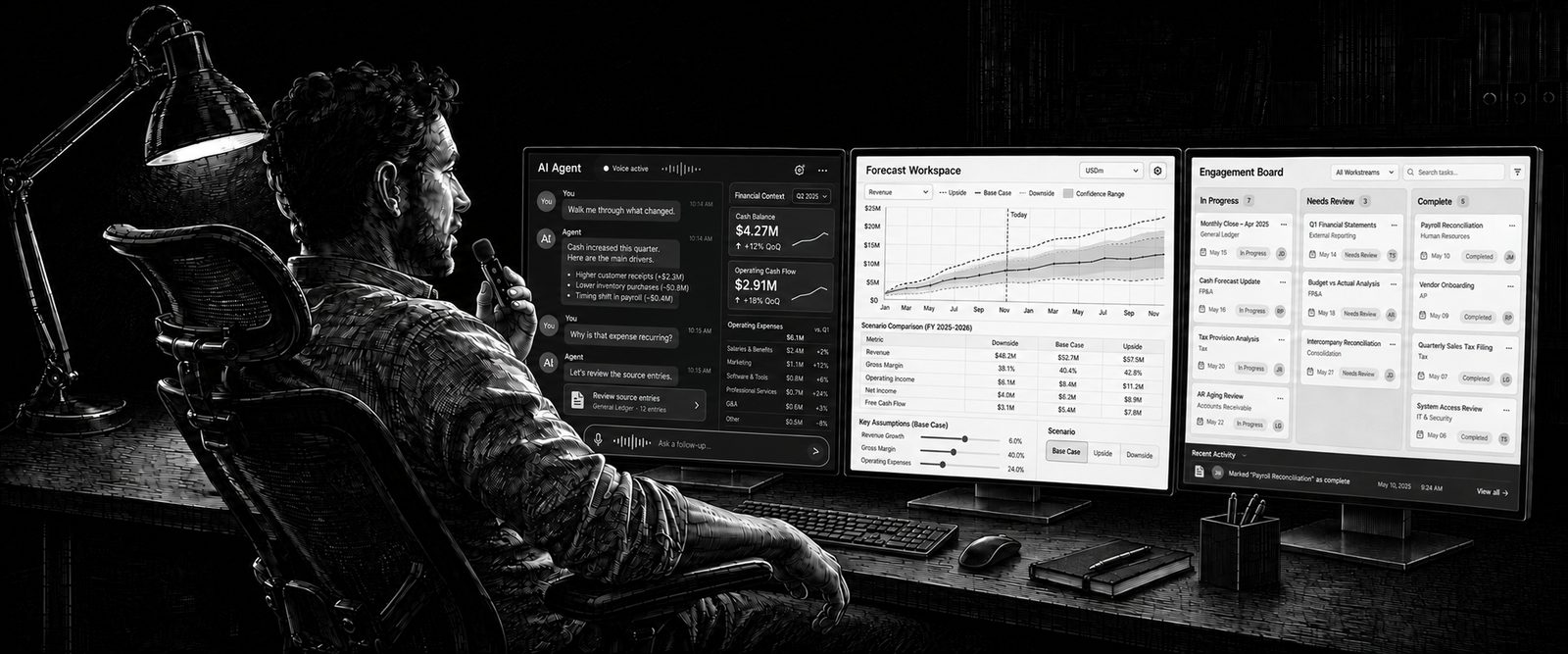
Imagine opening a monthly engagement and saying, “Walk me through what changed.”
The agent brings up the current results alongside the comparison period and starts explaining the movements that account for the difference. As it speaks, it highlights the relevant numbers and brings the supporting records into view.
Halfway through, I interrupt: “Hold on. Why are you treating that expense as recurring?”
It pauses, opens the underlying entries, and shows the assumption it used. I tell it that one of those items belongs to a one-time project. It updates the analysis and shows me the downstream effect, with the earlier version available for comparison. Then we continue the review.
The correction stays attached to the work, along with the reason we made it. Next month, I shouldn’t have to explain the same project again. If circumstances change, we can revisit the decision with that history available.
That is the combination of speech, vision, and shared context I expect to become much more important. I can point, ask, interrupt, and challenge an explanation while the actual work is in front of me. If I question a result, I can inspect its inputs and calculation, including areas the agent didn’t choose to highlight.
The quality of that return to the work will determine how useful the larger handoff really was.
Firms spend a lot of effort keeping people synchronized
The same problem exists across a firm. Status meetings, internal emails, project updates, handoffs, and management reports help people understand work they weren’t personally present for.
Some of that activity involves decisions and relationships that deserve a conversation. Some involves finding out which document arrived, who is waiting on what, or whether an assumption changed after the last review.
A meaningful part of management, as I see it, is context synchronization. We continually assemble a picture of the work so someone else can act on it.
Agents could take on more of the effort of maintaining that picture. They would need to track current information, preserve decisions, and identify contradictions or gaps. Keeping context accurate would itself be an ongoing responsibility.
If they can do that well, “What materially changed this week?” becomes a question the system can answer from the work, with evidence attached. We could spend less time preparing an update and more time discussing what to do about it.
That could change how work moves through a firm, how much a manager can stay close to, and where a team needs another person. It also leaves more room for the parts of leadership that involve setting direction, developing people, and building for the future.
The interface will become more fluid
Today, we work across a multitude of different apps. The numbers may be in Excel, the return in our tax software, the support in PDFs, and the questions in email. We spend a surprising amount of effort moving between those places and keeping their contents aligned.
I think we’ll increasingly interact with that work through an interface that can change around the task in front of us.
I might ask, “Show me the clients whose cash flow deteriorated this month and explain why.” The system would bring forward the relevant comparison, the drivers, and the supporting detail. If I select one client and ask about a hiring decision, it could generate a forecast with controls for the assumptions we need to explore.
The underlying ledgers, tax engines, source documents, and other systems would still matter. The views would stay connected to that foundation while changing to help us answer a different question.
That is what is meant by generative UI. The system creates the view and controls useful for the moment, with the engagement’s context intact.
Those views would still need to be familiar enough to use. I’d want to keep useful layouts, distinguish a new scenario from agreed work, and follow what changed. An interface that constantly rearranges itself would create its own catch-up cost.
What interests me is the possibility of durable context with flexible views. The conversation can move from analysis to review to a client decision without requiring us to reconstruct the work each time.
We need to be specific about professional value
If we seriously consider that broadly capable intelligence is available to us, we shouldn’t make professional value depend on models remaining bad at reasoning. When accountants say our judgment will become more valuable, we need to explain what that looks like for a client.
Judgment includes recognizing an assumption that deserves another look, deciding whether the evidence supports a conclusion, and understanding what a recommendation would mean for the person receiving it.
Agency matters alongside it: deciding what to pursue and helping turn that choice into action, while properly weighing the tradeoffs.
An agent may identify several technically reasonable strategies. The client still has priorities, relationships, and tradeoffs that determine which possibilities are worth pursuing. Part of our value is helping them make those priorities explicit and understand their choices.
Imagine a business owner considering implementing a specific tax strategy. We could ask the agent to bring forward scenarios that fit the owner’s stated goals and explain why it selected them. We could inspect the alternatives or change the criteria. A scenario with a better financial result might still demand a commitment the owner doesn’t want to make.
That is a conversation we should want to have more time for. More analysis becomes useful when it helps someone make a decision they understand and can act on.
We’ll also need to be deliberate about how newer accountants learn to do this. If agents handle more preparation, staff will have fewer repetitions of some tasks that traditionally developed their understanding. Reviewing evidence, testing alternatives, and explaining a conclusion to an experienced colleague could become a more explicit part of how we teach.
What I’d start changing now
I’d start with one recurring workflow and test a larger handoff. Define what a useful result looks like, give the agent the relevant context, and decide where it should return for review. Then look at how much work is still left with the person: clarifying instructions, answering questions, finding errors, and getting oriented.
That would tell me more about how to redesign the practice than the speed of the first output. It would show where the agent needs better context, where a process needs to change, and where my involvement adds value.
I’d also revisit what the client is buying. Is it a completed deliverable, an ongoing responsibility we carry for them, help with decisions, or some combination? The answer should shape the service and the people we need to provide it.
More room for relationships and life outside work
I expect some clients to want a service where agents handle most of the interaction. Others will place a high value on having a person who understands them, helps them prioritize, and takes responsibility for a recommendation. Those preferences won’t always divide neatly by how complicated someone’s situation is.
There is a version of the future where agents keep the work moving while the accountant spends more time with their client and developing a greater understanding of what they’re trying to accomplish.
There is also a version where some of the time goes back to the accountant’s own life: more time with their family, an afternoon spent building something, or just time away from their desk.
The technology creates possibilities. We still have to decide what kind of practice we want and how we want to use the capacity it gives us.
I don’t know exactly what accounting firms will look like two years from now, let alone ten years from now, but my belief that AGI is here gives me a reason to start working through these changes in my own practice today.