About
TaxClaw is the tax half of the workflow. Where LedgerClaw keeps the books all year, TaxClaw creates the tax workpapers and works up the return. LedgerClaw has only light tax functionality, so TaxClaw is the real thing: turning a shoebox of client documents, and a year of clean books, into a computed, tied-out return, with the reading done by AI, the math done deterministically, and the CPA in control of everything before it’s filed. It runs in my own practice today, and it’s on the same path to availability LedgerClaw is already on.
The flow mirrors how a preparer actually works:
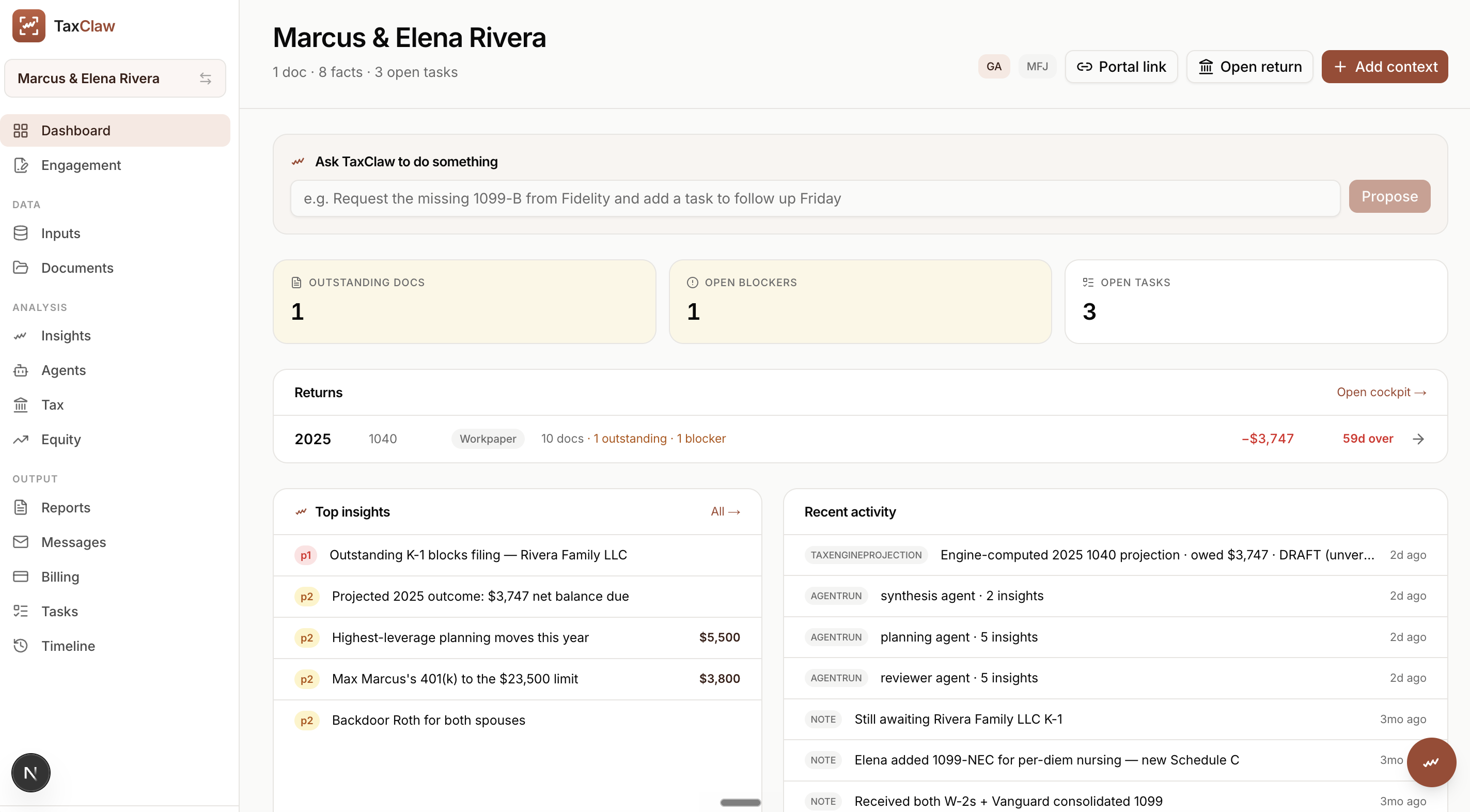
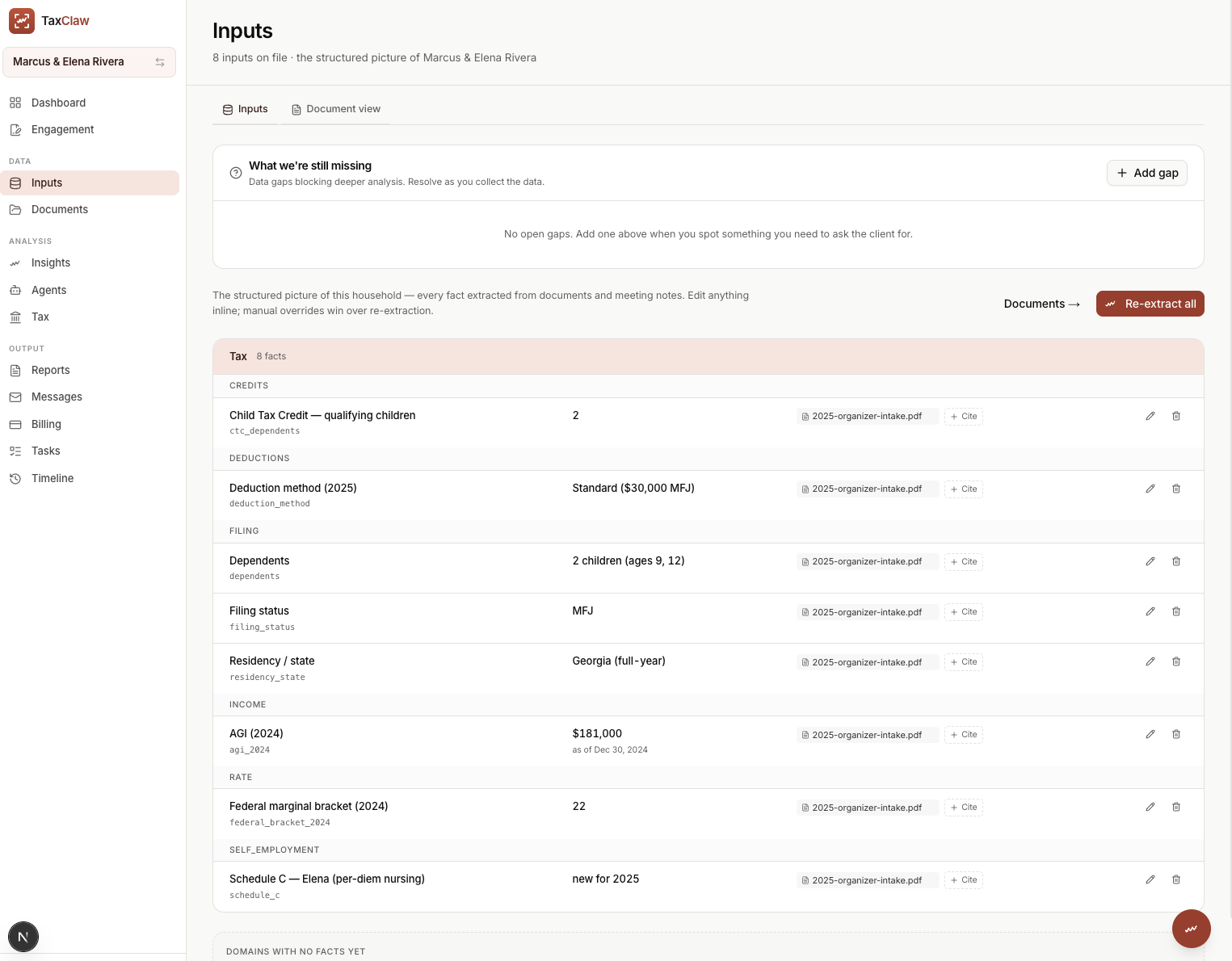
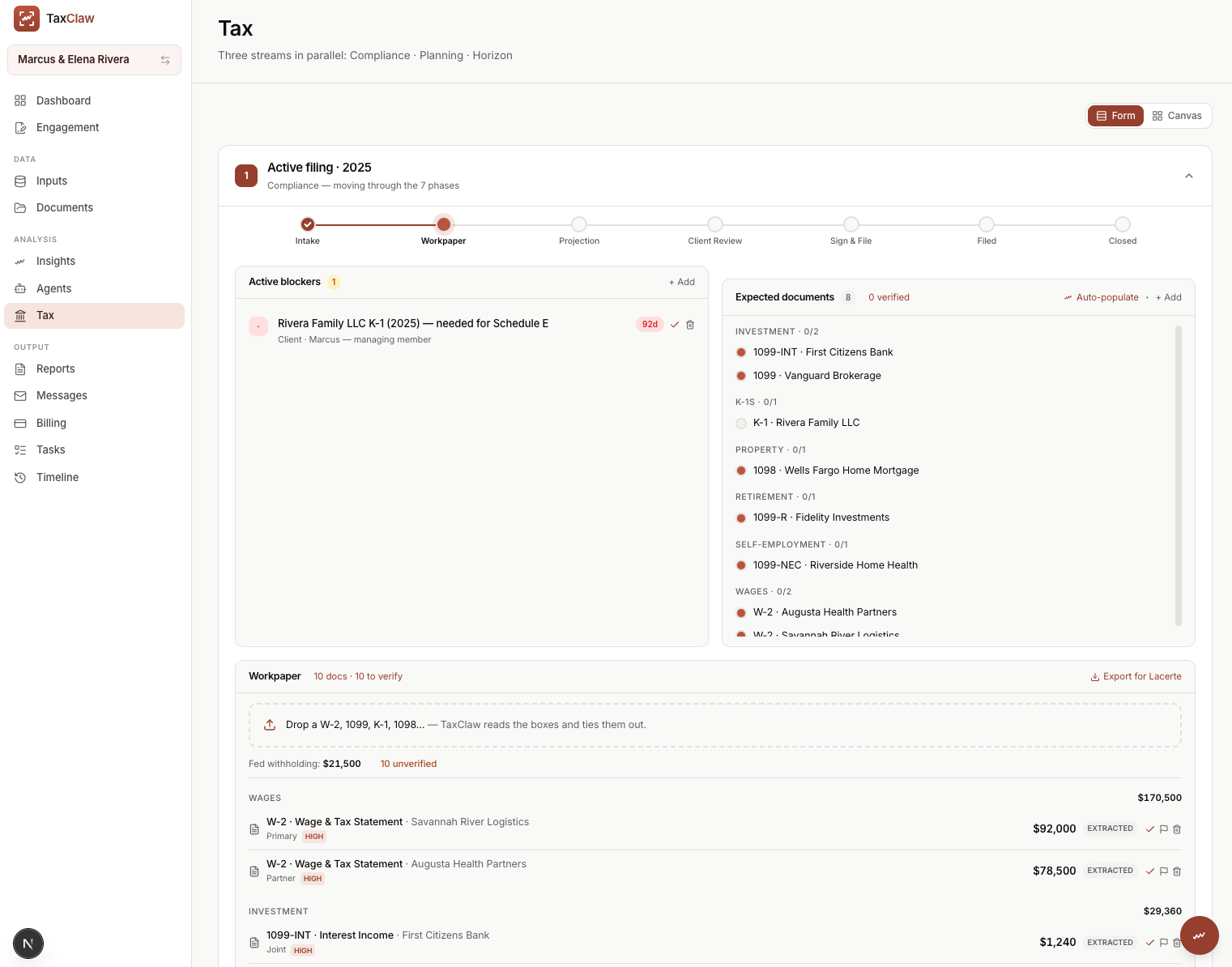
- Import the documents. Drop in W-2s, 1099s, K-1s, and 1098s; TaxClaw reads the boxes, files each as structured data, and tracks what’s still outstanding.
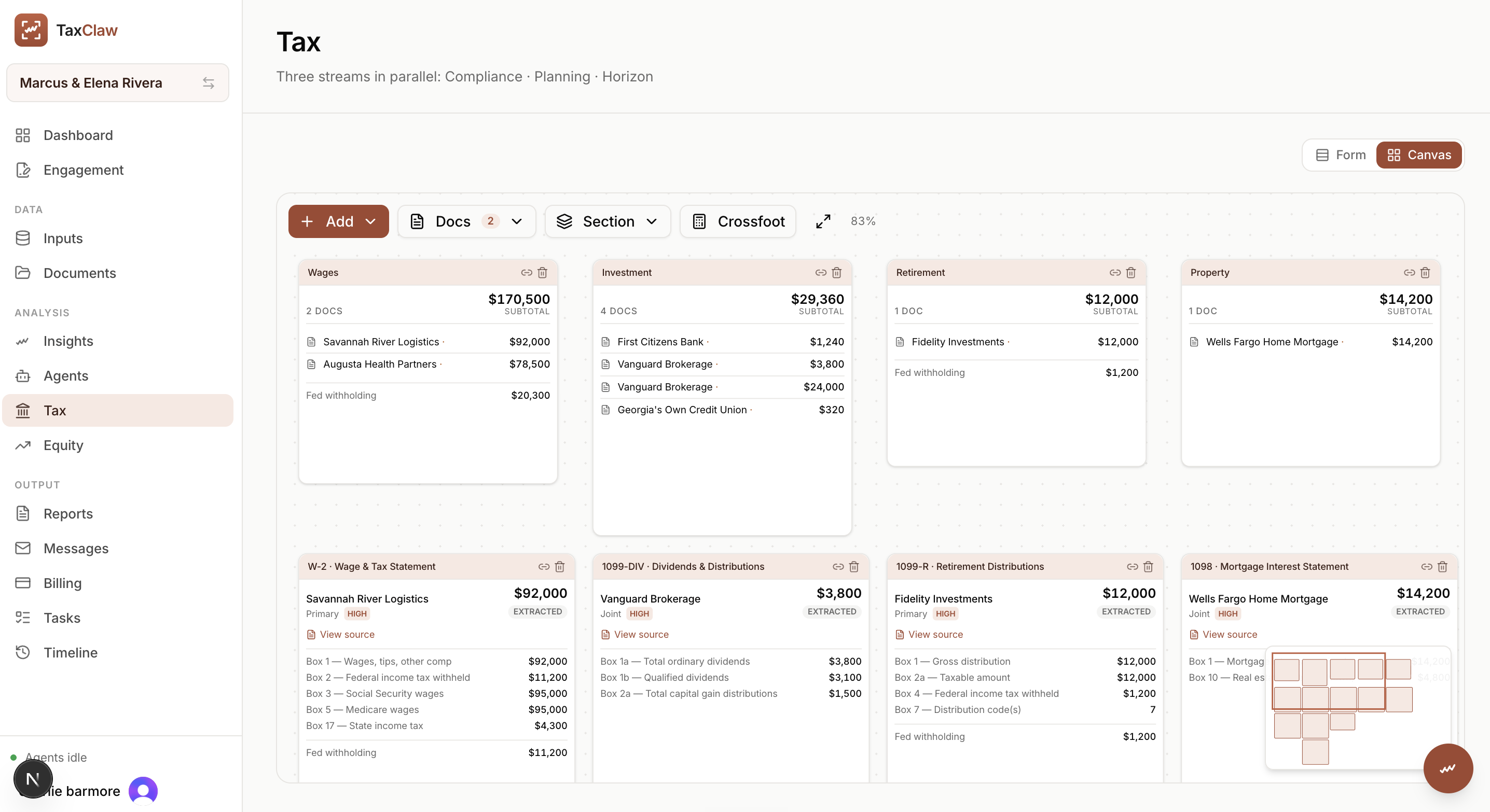
- Build the workpaper. Extracted forms roll up by category and reconcile against last year; missing, new, and changed items get flagged.
- Compute the return. A deterministic Form 1040 + Georgia engine calculates the return line by line (not an AI guess) and explains every number.
- Tie it out on a canvas-style workpaper. Toggle from the standard forms into an infinite-canvas workpaper: drag documents into sections, watch subtotals add up live, and crossfoot the whole thing back to the 1040 in real time, with notes, a calculator tape, and a link-arrow audit trail.
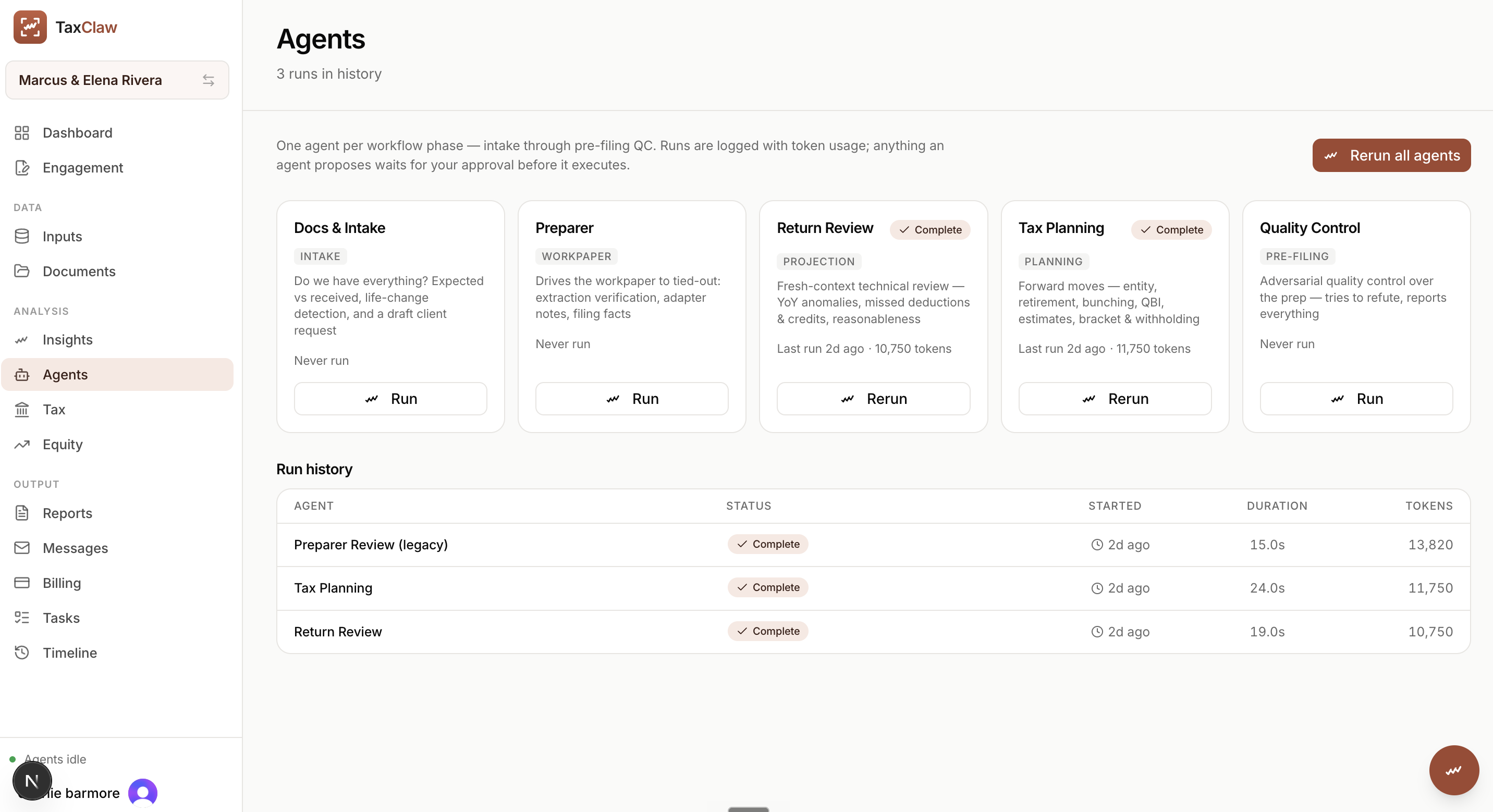
- Review, plan, and sign off. Flag items for review, run estimates and planning, generate client deliverables, and export to the filing software. Nothing is final until the CPA signs off.
It automates the grunt work (reading forms, chasing documents, tying out numbers) without handing over control of the return.
TaxClaw vs. LedgerClaw: LedgerClaw keeps the books right all year; TaxClaw creates the tax workpapers and works up the return. Same DNA: AI reads documents into structured data, the CPA reviews. Just a different deliverable and cadence.
The canvas began as a separate prototype, CanvasClaw, now merged in as TaxClaw’s spatial workpaper view. It’s private for now, running in my own practice, and on the same path to availability LedgerClaw is already on, once it’s hardened for client tax data and the engines are complete.
How I built it
The core idea: AI does the reading, a real engine does the math, and the CPA stays in the loop.
- A real tax engine, not a prompt. The math is a hand-built, deterministic Form 1040 + Georgia engine with “rules as data”: each year’s brackets and limits are swappable parameters. It covers the hard parts: QBI / §199A (with the wage and SSTB limits), AMT, NIIT, taxable Social Security, Schedule D, and CTC/ACTC.
- Proved correct, independently. The engine is validated to the dollar against PolicyEngine, a separate open-source tax model, with answers fetched live at test time so the check can’t be circular. 24 federal and 7 Georgia scenarios match exactly.
- Safe by default. Documents are read by Claude; numbers are computed deterministically; every action is logged and reviewable. Anything the engine can’t model is flagged for review, never silently guessed.
- Two apps merged into one. The canvas was a separate Vite + Electron prototype that I ported into TaxClaw’s Next.js stack as a view layer over the existing engine, reusing the backend instead of duplicating it.
- Shipped end to end. Local-first prototype → hosted production: Next.js, Postgres, Clerk auth, and field-level encryption.
- White-labeled by design. Today TaxClaw wears my firm’s color palette and CB monogram, since it runs inside my practice. The same theming is built to white-label to any firm down the road.